Every piece we have published, across every category. Use the filters to narrow the list.
Crest Nicholson has cut profit guidance at every update this year and now expects an adjusted operating loss of £30m to £40m. I think the macro environment is part of it, but other housebuilders are not seeing these same issues — this company is badly run. That doesn't take away from the fact that there is significant value here to be pulled out: a land bank of real value and a buyer's dream for a bigger construction group. Taking the April net asset value of £688.8m, cutting £80m off it and then discounting 30% gives £426.2m, or 165.98p per share, against a 44.15p share price — a value opportunity of +275.9%, a strong buy.
NatWest's commercial bank is doing a lot of the work, the retail bank is earning more before impairments, and impairments are the question mark over the coming period. I take pre-tax profit to £8,827.44m over the next 12 months, which after the 31% bank rate is 77.19p a share. On a 4% growth rate and a multiple of 9, less a 10% reduction for the time it takes to get there, that values the shares at 850.33p against 591.90p — a +43.7% value opportunity. Strong Buy, research grade A, risk factor 24%.
JD Sports is seeing weakness across the board — like-for-like sales negative in every region and a profit range that has been cut twice this year. I've taken the £725m midpoint, knocked off £215m of adjusting items, and come to earnings per share of 8.18p. On 1% growth, an 8× multiple and a -15% reduction, that values the shares at 60.07p against 94.94p in the market — a -36.7% value opportunity. Sell.
Nvidia has gone from $16.7bn of revenue to $215.9bn in five years, and the first half of this year grew 85.2% and 105.9%. Margins are strengthening, not drifting. I project $290.45bn of revenue, $191.7bn of pre-tax profit and 658.9 cents of earnings per share, and on 40% growth at an 8x multiple that gives a valuation of 22,139.04 cents against a share price of 16,285 cents — a value opportunity of +35.9%. Buy, research grade A, probability 50%.
OSB Group is a bank that is profitable, well capitalised and struggling to grow. Deposits are up 3% in nine months, the loan book only 1.9%, and profit after tax has gone from £410m in 2022 to £286m in 2025 — but £550m of buybacks has absorbed close to half of that fall at the per-share level. I expect a flat £286m post-tax this year, which is 81.5p a share on today's count. 81.5p with 2% growth and an 8× multiple gives 756.32p against 507.75p, a +49.0% value opportunity, so I'm giving this a buy.
Things do seem to be progressing quite nicely for Watches of Switzerland: group revenue up 15% to £974m in the half, the United States up 22% at constant currency, and adjusted profit up around 28% as the margin lost in 2026 comes back. My feelings are that this is all quite positive, but the shares seem to be quite highly valued, especially for a company that's not offering any dividends at this stage. On 51.2p of earnings, a 10% growth rate, an 8× multiple and a 6% uplift I get 781.52p against 745p — a value opportunity of +4.9%, which is a bit of a weak buy.
Budget 2026 lifts business rates relief for pubs to 35% and raises the National Living Wage to £13.21. What the two measures mean for Wetherspoon, Mitchells & Butlers, Marston's and Fuller's, and for the high street.
The Bank Corporation Tax Surcharge doubles from 3% to 6% for 15 months from January 2027. What Lloyds, NatWest, Barclays and the specialist lenders will pay, what the sector paid last year, and why bank shares did not fall.
John Healey's first Budget: which measures genuinely change the profitability of British companies, which are just good sound bites, and how the FTSE 350 reacted on the day — banks up, housebuilders down sharply, most sectors muted.
Machine Games Duty rises from 20% to 25% on higher-stakes machines from April 2027, a year after Remote Gaming Duty nearly doubled. What is actually changing, which operators carry the exposure, and whether the direction of travel matters more than this rise.
The Chancellor’s £4.7 billion Your First Home equity loan scheme is good news for the direction of policy, but at 20,000 additional homes it is too small to move the housebuilders’ figures.
Electricity discounts, investment finance and industrial support may provide a substantial boost to parts of British manufacturing, from aerospace to chemicals and advanced engineering.
The £100 energy payment, the VAT cut on electricity, the end of gas standing charges, the fuel-duty extension and the cash ISA reprieve all made headlines. Why none of them should move a company valuation, and why the real achievement of John Healey's first Budget was in the gilt market.
Atalaya is a European copper producer with one producing mine at Riotinto, a stable jurisdiction and debt under control. Copper has done the heavy lifting: production fell -14.7% in the first half of 2026 yet revenue rose 3.9% and profit after tax rose 40%. On 65.43p of forecast earnings, a 12% growth rate and an 8x multiple I get a formula valuation of 1,025.94p, less 10% for copper's volatility, giving an actual valuation of 923.35p against 904.50p — a value opportunity of +2.1%. That isn't enough to warrant an investment, so it's a hold.
Inchcape is no bigger today than it was in 2019 — the gross margin, not the top line, has done all the work. The growth plan buys distributors and wins contracts, and I think that costs money before it earns it. On adjusted earnings per share of 80.8p, 3% growth and an 8x multiple I get 801.54p against a price of 685.50p, a +16.9% value opportunity. That isn't high enough for me to buy: Hold, research grade A, probability 40%.
Whitbread's rooms keep growing and the profit keeps shrinking: revenue up 2.0% to £1.57bn, adjusted profit before tax down -9.1% to £286.8m, and statutory profit before tax down -62.0% after £177.7m of adjusting items. They're struggling with their growth, so I'm applying a 20% reduction to the valuation. On 195.40p of earnings, 1% growth and an 8x multiple I get 1,350.60p against a share price of 2,510p — a -46.2% value opportunity, 60% probability, research grade A. I consider Whitbread to be a short.
Wetherspoon sold more and earned less in FY26: revenue up 5.2% to £2,238.0m, but operating profit before separately disclosed items down 17.9% to £120.2m. A well-run business with a property estate worth a good deal more than the balance sheet shows, but with earnings that will not escalate from here. On 59.5p of basic earnings per share, 4.5% growth and an 8x multiple my valuation is 647.36p against 915p — a value opportunity of -29.3%. Sell.
Why US shares rose after September's weak jobs report, explained in six simple animated steps.
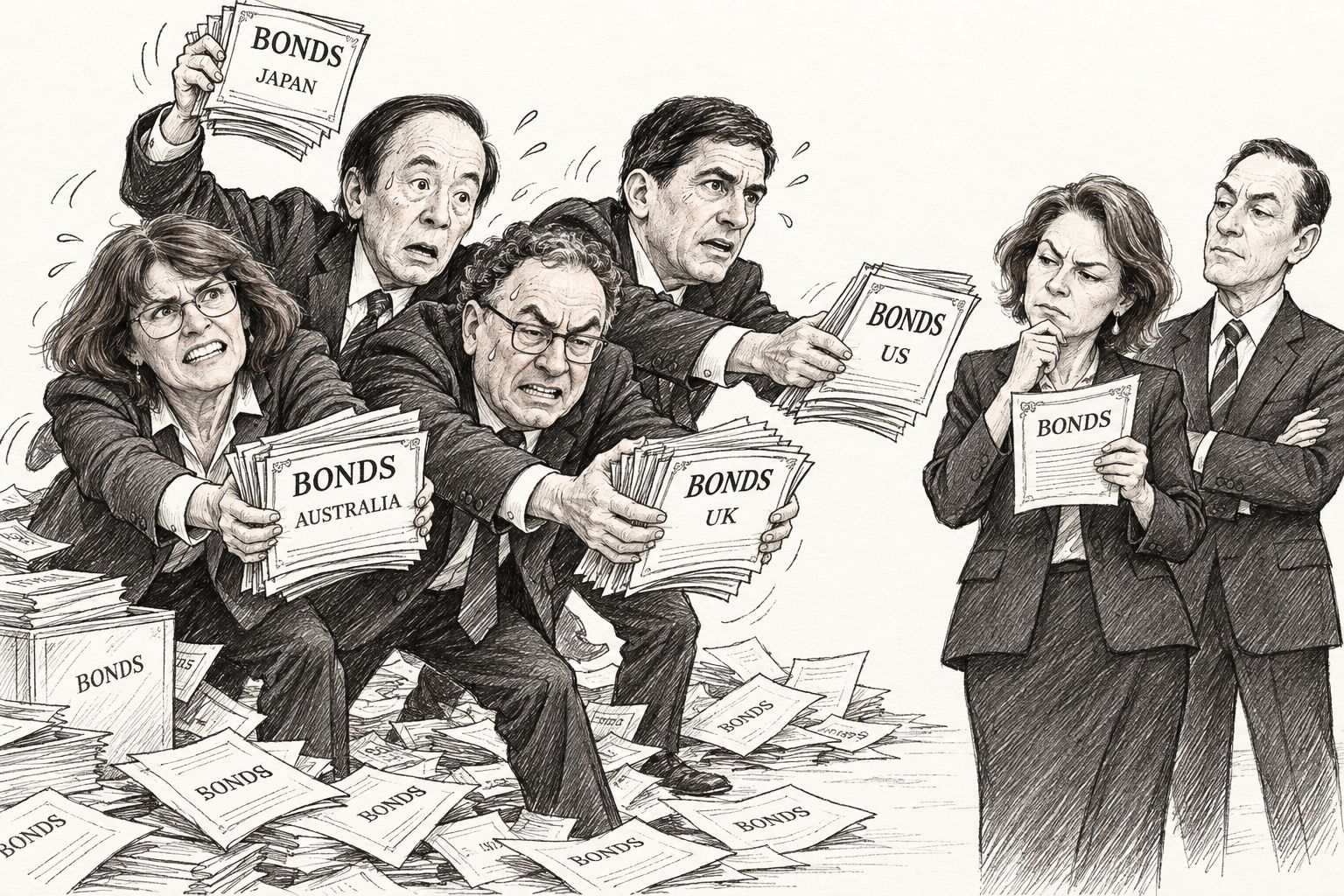
Global government bonds came under further pressure on 1 October 2026, with 10-year yields in the US, UK, Japan and Australia at or near multi-decade highs. What is driving the sell-off, and what to watch next.
Card Factory's interim results to 31 July 2026: group revenue up 5.3%, but almost all of it is the Funky Pigeon acquisition. UK store like-for-likes fell 2.0%, adjusted profit before tax slipped to £12.7m and net debt rose to £87.4m. On 8.9p of EPS, a 2% growth rate and a 10% valuation reduction I get 63.92p against a 72.70p share price, a -12.1% value opportunity. Sell.
Revenue up 1% in the half, reported operating profit down 14.4%, and costs I expect to rise by about €1.35bn this year against roughly €330m of extra revenue. The balance sheet is in good shape, but I am nervous about the US exposure and a thinner 2027 fuel hedge. On an earnings override of 59.14c, a multiple of 8, growth of 4.5% and a 10% reduction, I get 579.10p against 425.30p — a 36.2% value opportunity. Buy, research grade A, probability 50%, though I am not going to hold them right now.
GSK is a very large, very stable pharmaceutical business, but sales are creeping up at only 3–4% a year and far too much adjusting is going on in the income statement. I have thrown out the company's 172.0p adjusted earnings and built my own figure of 163.65p per share by adding back only the adjustments I think are permanent. On 6% growth, an 8× multiple and a 5% uplift that gives 2,034.44p against a share price of 1,817.50p — a value opportunity of 11.9%, probability 50%, research grade A. Hold.
Currys' 17-week update is an extremely light one: group like-for-like revenue up 7%, gross margins stable, guidance unchanged. But the business still turns only 1.5p of every pound of sales into profit, and the gross margin has stopped improving. On 13p of EPS, a growth rate of only 2% and an 8.0x multiple I get an actual valuation of 120.64p against a 151.70p share price — a -20.5% value opportunity. Reduce.
Six months of public ship-tracking at the Strait of Hormuz, 14 March to 3 September 2026. IMF PortWatch, independent directional AIS, Kpler via Reuters and AXSMarine via Signal Group, each charted on its own terms: a collapse, a brief June reopening, and a second squeeze.
Persimmon's first half delivered 13% more completions, 13% more new housing revenue and the joint-best net private sales rate in the sector. But the extra volume came from lower-margin housing association work, the operating margin slipped 30 basis points and net cash swung £288m into a £165m net debt position. On anticipated earnings of 98.2p and 8% growth my base valuation is 1,288.38p, a +12.7% value opportunity against 1,143.50p; my longer three-year valuation, discounted 35%, gives 1,411.49p and +23.4%. Positive, but not enough for investment — Hold.
Next beat its own second quarter forecast by £70m of full price sales and pushed only £15m of it through to profit — that restraint is exactly why the upgrades keep coming. It is an exceedingly well-run company, but almost all of the positivity is now in the price, and the growth is coming from overseas and Label rather than the core UK brand. On the company's own guided earnings per share of 812.9p, a 6% growth rate and a multiple of 8, I get a valuation of 9,624.74p against 15,045.00p — a value opportunity of −36.0%. Reduce.
Keller have had quite a monumental year: revenue up 10.3% to £1.61bn, underlying operating profit up 17.1% at constant currency to £117.9m, margin at 7.3% and net debt down -74.1%. A lot of the growth relates to a single project, I-40, which will slowly wind down — but the order book is a record £1.9bn and I think something else comes in to replace it. On 261.50p of forecast earnings, a 25% growth rate and an 8.00x multiple, that gives 6,276.00p against 3,108.00p — a value opportunity of +101.9%. Buy, grade A+, probability 50%.
JPMorgan is compounding earnings per share at 17.7% a year and the Commercial and Investment Bank is pulling away, with second-quarter 2026 net income of $21.2bn and record revenue in every line of business. The rate tailwind has largely done its work — net interest income excluding Markets is guided broadly flat at around $95bn — but the franchise is very well run and does not get itself into trouble. On 2025 earnings per share of $20.02, a 15% growth rate, a multiple of 9 and a 5% uplift, I get $444.59 a share against $348.40: a value opportunity of +27.6%. Buy, research grade A, probability 50%.
JD Sports has cut profit guidance again, with group like-for-like sales down -3.1% and North America down -6.8%. Three straight years of falling adjusted earnings per share, £1.09bn of pre-tax profit adjusted away in four years, and a yield of only 1.3% while you wait. On 11.70p of earnings, 1% growth, an 8x multiple and an -8% reduction, I get 93.00p against a price of 92.42p — a value opportunity of +0.6%. That is no margin of safety at all: Sell, research grade C, probability 50%.
NatWest seems to really have managed to get their act together. Income up 11% to £8,862m, the margin up 20 basis points to 2.48%, impairments flat at 19 basis points, and the Evelyn Partners deal shifting the income mix towards fees. On a full-year earnings estimate of 84.6p, a 9% growth rate, an 8x multiple and a 5% uplift, that gives an actual valuation of 1,222.30p against 716.00p — a value opportunity of +70.7%. NatWest continues to be a strong buy for me.
ConvaTec keeps growing — four divisions, none of them shrinking, and revenue up 6.6% in 2025. But I'm valuing it on reported earnings of 8.60 cents, not the adjusted 17.6, because the amortisation of acquired intangibles runs through the company every single year. Net borrowing of $1,450m on $2.4bn of sales is too high. On a 6.5% growth rate and an 8x multiple that gives 104.58p against a 229.60p share price — a -54.5% value opportunity. Sell.
July's CPI rose to 2.9% on the Ofgem cap increase - while core held at 2.6%, services fell to 3.4% and private-sector pay slowed to 2.8%. What the split means for the Q4 peak, the Bank and the path back to target.
Breedon Group FY2025 and H1 2026 share evaluation: revenue has risen every year since 2022, but the growth is bought rather than earned — on a like-for-like basis revenue fell 3% in 2025 and 5% in 2024. Reported earnings per share are down 27% from the 2022 peak, net debt has reached £690.5m, and the payout ratio has run above the company's own target. Value opportunity −62.4%. Proposed action: Avoid.
Greggs' H1 2026: total sales up 7.2% to £1,101.5m, pre-tax profit up 19.7% to £76.0m, and 2,773 shops — but like-for-like growth of just 2.1%, and a valuation of 1,762p against a 1,946p share price. Well run, and fully priced.
Barclays' H1 2026: income up 11% to £16.5bn, pre-tax profit up 16.6% to £6.1bn — 2.1% ahead of consensus — and a return on tangible equity of 14.8%. Strip out the American Airlines gain and the one-off impairment and the half is still good. On 58.95p of override earnings at an 8x multiple I get 750.41p against 530.40p — a value opportunity of +41.5%. Buy, grade A+. The card-arrears drift is the thing to watch.
An interactive atlas of the eighteen companies that supply water to the UK. Map every service area, then shade it by customers, incidents, capital spending or profit after tax — from Thames Water's £585.5m loss to Yorkshire's £270.7m profit.
Severn Trent's FY2026 profit jumped on the new regulatory period, but more than £10bn of debt and acute political risk cap the upside. On my 8x framework the shares screen 19.9% too expensive. A Hold.
British American Tobacco's FY2025 looks like a record year — reported EPS 349.1p — but on normalised earnings the shares screen 15.4% too expensive at 4,382p. A Hold, grade B.
Burberry's Q1 update shows green shoots — Americas +12%, Greater China +9% — but on normalised earnings the shares are 44.1% too expensive at 1,082p. A good brand, but a Sell.
All 50 Crest Nicholson developments mapped — 42 live, 8 in the pipeline. The estate is concentrated in Southern and Eastern England, where a £414k open-market average selling price is most exposed to mortgage affordability.
Revenue down 20.8%, a £35.2m pre-tax loss and a covenant waiver to 31 August — yet Crest Nicholson's discounted net assets are worth 160.97p against a 67p share price.
Centrica FY2025 share evaluation: a £51m post-tax loss after £1.36bn of profit in 2024, statutory numbers whipsawed by energy prices and derivative re-measurements — but net cash on the balance sheet, a quarter fewer shares, and capital flowing into long-duration infrastructure. After a 24% fall since April, the shares trade almost exactly at my fair value. Proposed action: Hold.
Broadcom's FY2025 results are monumental — revenue up 23.9% to $63.9bn and reported earnings per share of 477 cents. But at $376.71 the market is extrapolating a volatile, high-thirties growth rate indefinitely. On my framework the shares screen dramatically overvalued: value opportunity −68.1%. Proposed action: Sell.
BP share evaluation: reported profits have been abysmal — largely the self-inflicted cost of unwinding an over-ambitious renewables push — while the underlying business still made around $7.5bn. On a deliberately conservative 37.4p adjusted earnings base with a 10% reduction for the impairment overhang, my valuation is 323.14p against 455.60p — a value opportunity of −29.1%. Verdict: overvalued; I am not paying up for BP here.
National Grid FY2025 share evaluation: a genuinely improving, defensive, regulated compounder with a real US growth story — margins at 77.4% and profit on turnover of 18.8%. But guidance points to around 7% earnings growth, and I will not chase a 7%-growth utility at this multiple. Value opportunity −34.5%. Proposed action: Sell.
Watches of Switzerland FY26 share evaluation: strong results on US growth, cash generation and balance-sheet repair — but the 53rd week flattered the headlines, margins contracted, and roughly 85% of the statutory profit jump came from exceptionals washing out. At 749.50p the price carries takeover optionality above my 662.52p valuation. Proposed action: Hold.
James Halstead share evaluation: a solid, cash-generative flooring manufacturer with a 6.9% yield, a 49-year record of dividend increases and a strong net-cash balance sheet — but essentially flat sales since 2020, no visible growth catalyst, and a long-term share-price slide. My valuation is 90.02p against a current 127.60p — a value opportunity of −29.5%. Proposed action: Sell.
London's blue-chip index has just delivered its best year since 2009, broken 10,000 for the first time and re-rated in the process. I still think the valuation case holds — but the composition that got the index here is the same composition that could take it back down.
The headline drop is real, but vacancies are at a four-year low, payrolls are down year on year, and wage growth has cooled. With inflation expected to keep grinding higher into the summer, this looks like a labour market that has stopped worsening — not one that is starting to recover.
March CPI came in at 3.3%. The obvious explanation is the Middle East. The less obvious story is everything underneath — sticky services, wage pass-through, and a Chancellor with very little fiscal room.
The NASDAQ keeps climbing, UK airlines bounce back, and I've closed my position. Why the calm doesn't convince me and what the Trump administration's escalation means for short-term opportunities.